
LeFlore County Release Meanings
A LeFlore County release can mark the end of local custody, but the word does not name one legal result. Bond, recognizance, dismissal, a court order, time served, completion of a local term, parole, and full sentence discharge all have different effects. Probation may begin without a prison stay. A transfer also closes one facility's custody entry even though confinement continues elsewhere. The release disposition and destination matter more than the fact that a name vanished from view.
County detainees, state prisoners, and juveniles are held under separate systems in LeFlore County. The LeFlore County Detention Center records county bookings and physical movement. The Oklahoma Department of Corrections, or ODOC, controls state prison sentence records. Juvenile access depends on Title 10A, court orders, and the requester's authority. A federal or immigration hold adds another possible receiving agency. The first task is therefore to identify the last facility and the legal custodian.
| Release entry | What it can mean | Next record |
|---|---|---|
| Bond or court order | Local release is authorized if no hold remains | Jail release entry and signed court order |
| Time served or local completion | The county term ended | Booking/release sheet and judgment |
| Parole | Conditional release under ODOC supervision | ODOC status, validated parole result, supervision office |
| Discharge | The listed sentence is complete | ODOC discharge record, checked against other cases |
| Transfer | Custody continued with another authority | County movement record and receiving system |
LeFlore Release or Transfer?
LeFlore's county center has a mixed-custody history that makes this distinction especially important. The FY2024 state audit reports prisoner-custody revenue from both local governments and ODOC. It also describes the Detention Center Authority as a public trust formed in 1971 to hold adults and youth before hearings, on sentence, and while they awaited placement. A person kept there may therefore have been held for a local case, a state placement, or another authority.
A departure from the building is not enough to prove a return to the community. Ask whether the maintained entry says released, transferred, remanded, or received by another agency. A detainer is a request or authority that can keep a person in custody after the local basis ends. If ODOC, another jail, the U.S. Marshals Service, or ICE became the receiving authority, follow that system. This keeps a county movement date from being mistaken for the end of all custody.
Key distinction: a closed LeFlore County booking may record a transfer. The destination field is needed before describing the event as a community release.
LeFlore County Release Record Fields
The core county record is usually a booking/release sheet, jail-management entry, or movement record. LeFlore County does not publish a standard online form showing every field, so a request should name the maintained facts needed. Some fields may not exist in one document. Others can be redacted under a lawful exemption. Ask for existing entries and reasonably separable public portions instead of asking staff to write a new account.
| Field to request | What it establishes |
|---|---|
| Full name, alias, booking number | Connects the release to the correct booking |
| Booking date and time | Sets the start of that custody episode |
| Actual release date and time | Shows when the jail entered the physical movement |
| Disposition or reason | Distinguishes bond, order, time served, completion, or transfer |
| Release authority | Links the action to a bond, court order, or other legal basis |
| Hold or detainer | Shows why community exit may have been delayed |
| Destination or receiving agency | Identifies continued custody after a transfer |
| Case number and charges | Connects the entry to the right court proceeding |
A booking photo is a separate requested item. It shows appearance at booking, not guilt, case outcome, or release. The release disposition and physical movement entry supply the missing context.
Request LeFlore Release Records
The Sheriff's Office says a request must be written at its office or sent through the online open-record request form. Although the county page uses “FOIA,” local access is chiefly governed by the Oklahoma Open Records Act. Keep the request narrow. A named booking is usually easier to identify than a broad list. The form asks for a name, phone, email, and a free-text description.
- Identify the person with a full name plus a birth date, booking number, or case number when known.
- Give the approximate booking period and ask for the existing booking/release sheet or jail-management release entry.
- Name the fields needed: actual release time, disposition, authority, holds, and destination if transferred.
- Ask for the booking photo separately if it is relevant and maintained.
- Request a cost quote before copies are made and ask for the legal basis if material is withheld.
The posted copy rates are $0.25 per page and $1 per certified page. Audio or video costs $3 on disc or $8 on USB, and outside storage devices are not accepted. The form also posts $5 per quarter-hour for commercial-request labor. No response deadline appears on the form, so none should be assumed. State law calls for prompt, reasonable access while allowing time for lawful review.
100 S. Church Street
Poteau, OK 74953
918-647-3426
Detention Center: 918-647-5013
LeFlore Release Records After Lawson
A local court decision shapes how the county jail trust may respond to a records request. In Lawson v. LeFlore County Detention Center Public Trust Security Commission, the Oklahoma Supreme Court rejected the trust's attempt to rely on the Open Records Act definition of a law-enforcement agency for the exemption at issue. The decision is specific and does not erase every other exemption. It does prevent an overbroad trust-based shortcut.
The official Lawson opinion shows the controlling text and history.
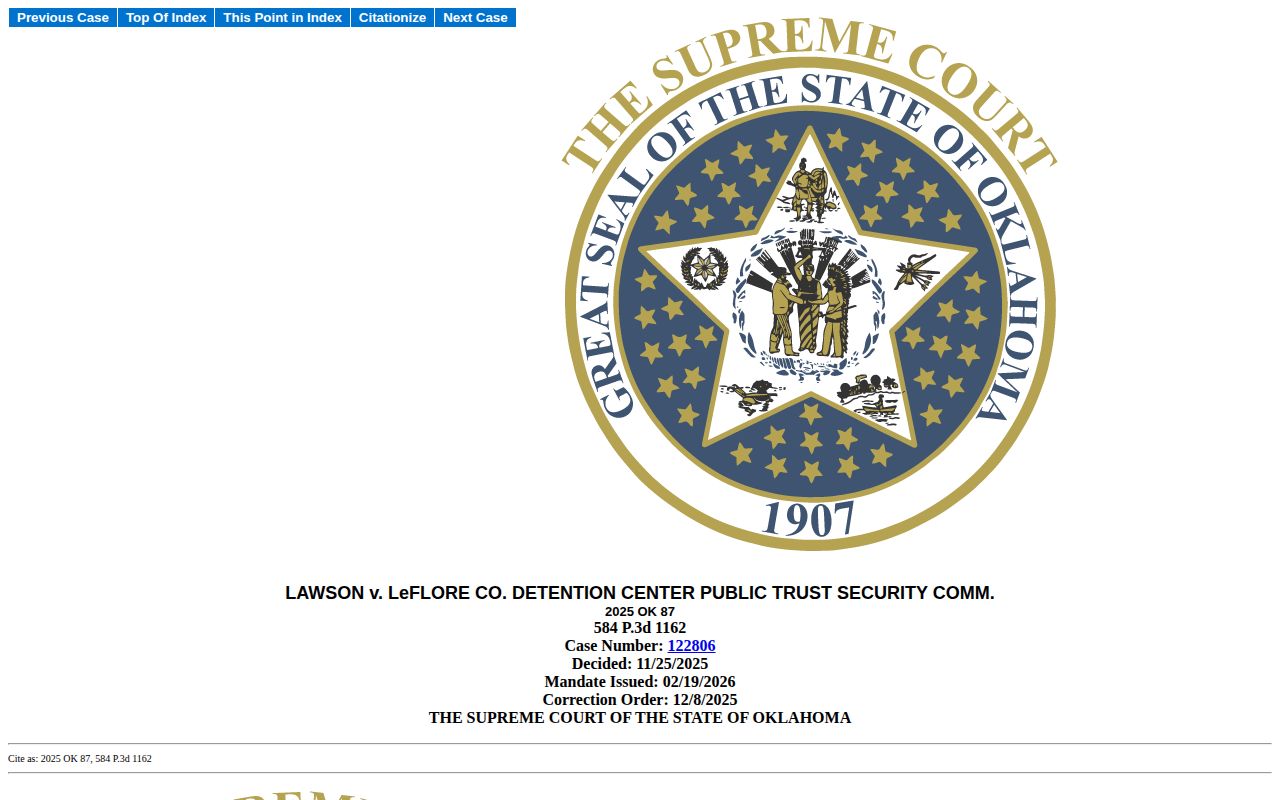
That ruling supports a focused request for maintained, nonexempt release fields. Oklahoma's Open Records Act still allows lawful limits for juvenile, medical, victim, security, sealed, and other protected material. A requester should ask for separable public portions and the cited basis for any withholding.
Expunged LeFlore Release Records
Oklahoma expungement is a petition-and-order process under 22 O.S. §§18 and 19. Eligibility depends on the case category, outcome, record, elapsed time, and other statutory facts. No single wait period fits every case. When a court enters an order, ordinary public access to covered material can be restricted. Juvenile records have their own Title 10A rules, and protected matters should not be forced through adult search tools.
A later failed search does not prove that a LeFlore County booking or release never happened. It may reflect an expungement, sealing order, corrected identity, record-retention rule, or a portal change. The correct response is to respect the access limit and use the lawful court or agency channel. Old cached copies do not override a sealing order. A release record and a booking photo may also receive different treatment because they are separate records.
Find LeFlore County Released Inmates
Start with the last known facility, not a broad name search. LeFlore County contains a county detention center, an ODOC prison, and a juvenile detention center. Federal or immigration custody can also arise through a case or detainer even though no dedicated federal or ICE facility was verified in the county. Use at least two identity points. A common name alone can join records from different people.
- For a county booking, call the Detention Center at 918-647-5013 for current-status routing, then request the booking/release entry in writing.
- Search the LeFlore court case for a bond, dismissal, release order, judgment, amended sentence, revocation, or completion event.
- If the person entered state custody or supervision, search ODOC by name or DOC number and confirm an abbreviated result through ODOC records.
- Use Oklahoma VINE for a reported custody event or future notification, then confirm the event with the reporting agency.
- For parole, check the Pardon and Parole Board docket and validated result, followed by ODOC movement and supervision status.
- For a federal sentence, use the BOP locator and federal docket. For current ICE detention, use the ICE locator.
The county sheriff does not publish an official live roster or release feed. That makes the underlying record more important, not less. For a defined same-day range, the LeFlore County 24-hour release process explains how to frame a dated request. A court order may authorize release, but the jail movement record shows whether it happened after all holds were checked.
LeFlore County Release Feed Status
The official sheriff website has no inmate roster, booking feed, recent-release archive, 24-hour view, 72-hour view, booking-photo gallery, or verified jail app. There is no honest online window, field list, refresh rate, or retention period to quote. Sites that use the county jail name but operate outside the official county domain should not be treated as county records.
The official LeFlore County sheriff site shows the available public navigation and the absence of a release list.
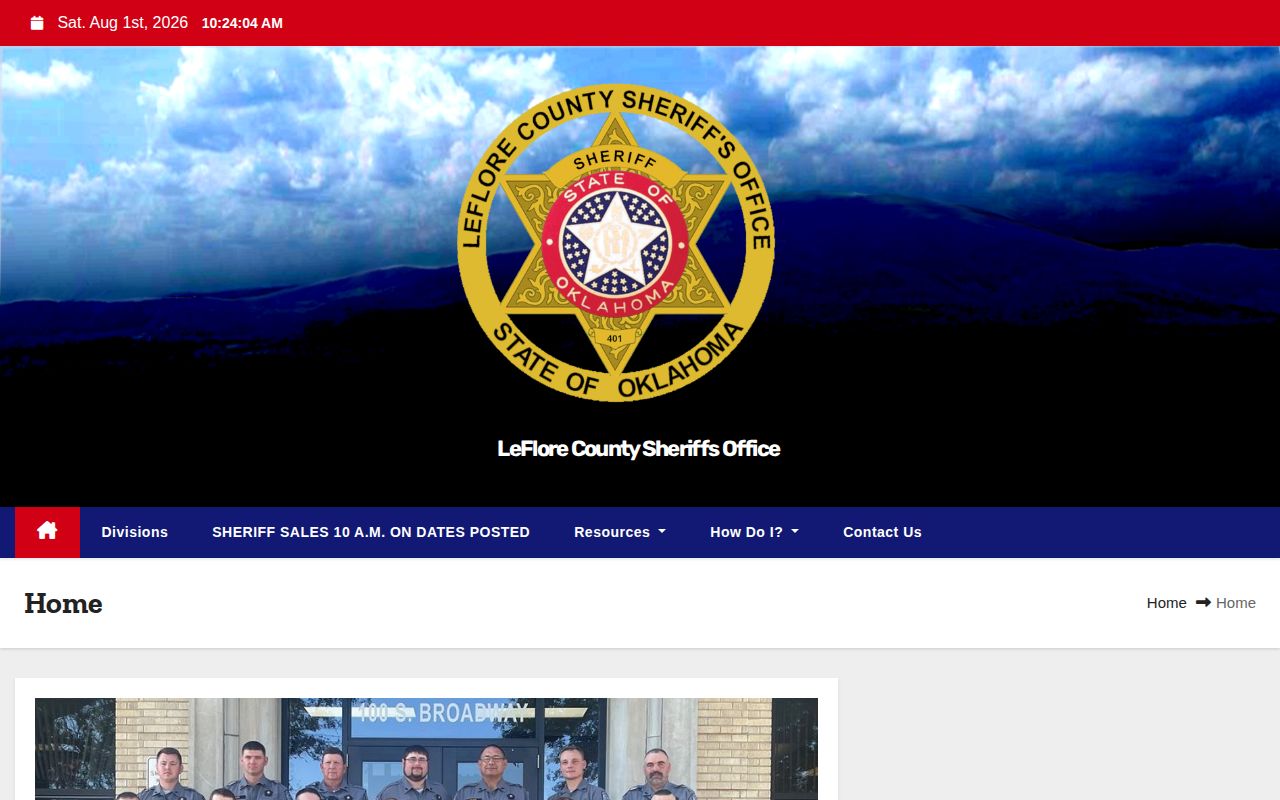
For one person, ask for the named booking/release sheet. For a 24-hour or 72-hour period, state exact start and end timestamps and ask whether an existing release report can be produced. The custodian is not required to create a new analysis that is not maintained. Same-day entries and VINE events can lag, so a direct check remains part of the process.
ODOC LeFlore Release Search
The ODOC Offender Lookup covers Oklahoma corrections records, including state imprisonment and ODOC supervision. It does not cover every person released after a county booking. Search by the known DOC number when possible, or compare a name result with age, offenses, and location. Read the status, facility or supervision information, and sentence entries that are actually shown. The public result is abbreviated and may contain data-source issues noted by ODOC.
| Search point | Use | Limit |
|---|---|---|
| DOC number | Best public identifier for an ODOC record | Does not identify a county-only booking |
| Name | Finds possible state records | Requires identity checks |
| Status and location | Shows reported prison or supervision placement | Can be abbreviated or delayed |
| Offense and sentence entries | Helps match the correct case | Not an exact account of time to serve |
The official interface demonstrates the ODOC search and its warning.
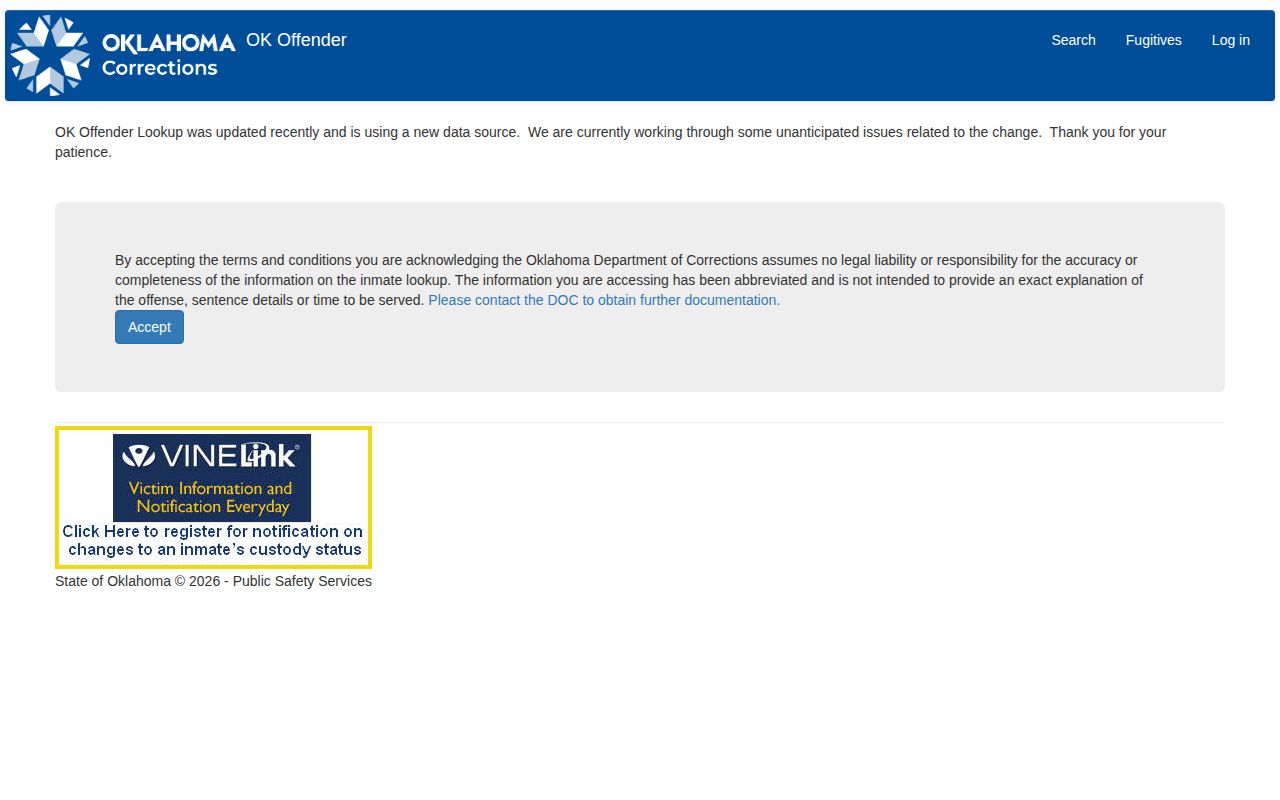
ODOC says an exact projected date is generally confidential without a legitimate need. An inmate receives days remaining monthly, while credits, misconduct, and achievements can change the tentative calculation. For a past release or discharge, request the movement transaction or discharge record from ODOC Legal Services rather than assuming that one completed sentence ends every case.
LeFlore Court Release Events
LeFlore district-court events can be searched through OSCN, with ODCR as a secondary index. Useful entries include bond, dismissal, a release order, judgment and sentence, time-served credit, sentence modification, revocation, and discharge. An index line is not always the signed document. The LeFlore Court Clerk, reached at 918-647-3181, is the source for the filed order when exact language matters.
The OSCN docket search provides the county and party search route.
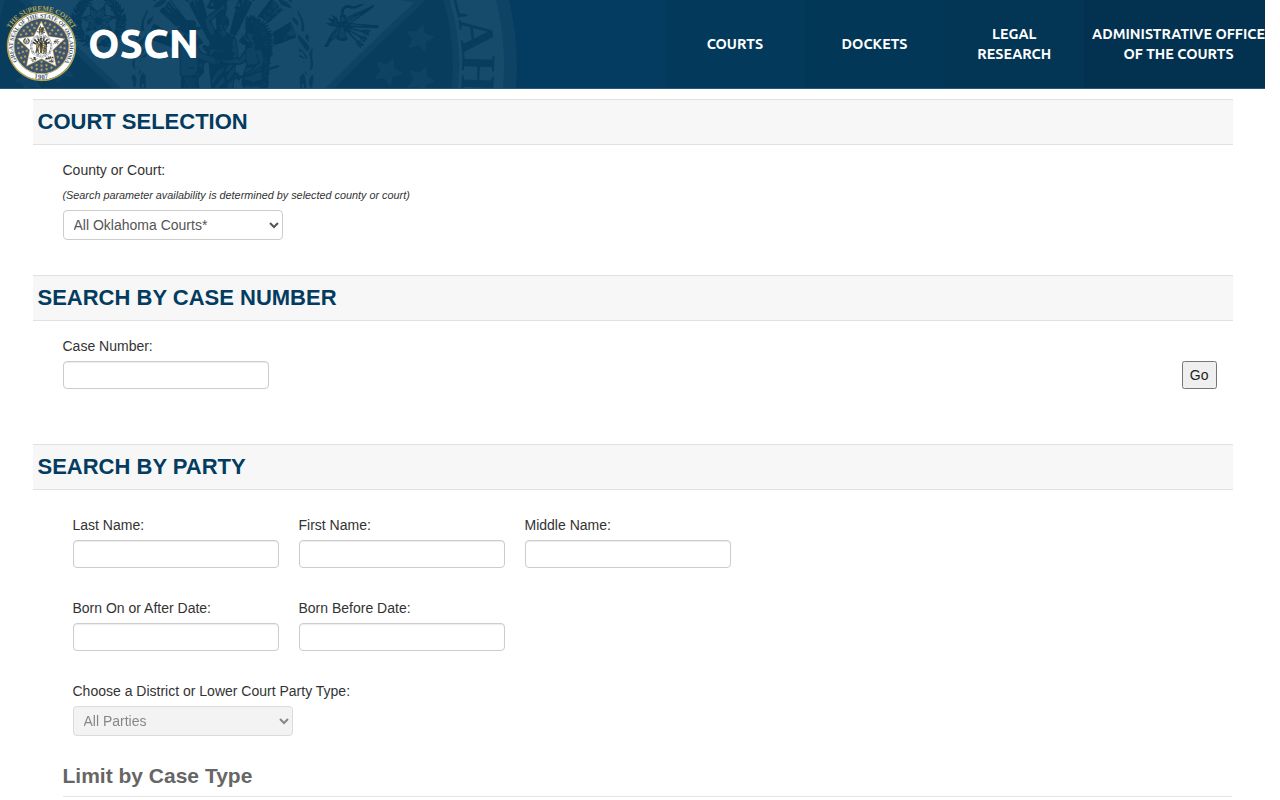
A court event shows legal authority. The jail shows physical execution. Bond can be posted while another county warrant, ODOC hold, federal hold, or ICE detainer remains. If the dates conflict, label each one separately: order filed, bond posted, jail movement, ODOC reception, or release to supervision. Do not collapse distinct events into one release date.
LeFlore Release Supervision Records
Oklahoma separates parole decisions from field supervision. The Oklahoma Pardon and Parole Board considers parole and may grant or recommend it, based on the case. ODOC supervises parolees and DOC probationers. Parole means conditional release from imprisonment. Probation may be imposed without a prison release. Discharge means the listed sentence has ended, though other active cases must still be checked.
Begin with the ODOC profile, then use the official supervision office directory. The Poteau office is at 106 Rogers Avenue, Poteau, OK 74953, and can be reached at 918-564-6009 for public routing. ODOC also maintains a separate fugitives search for possible absconder or retake authority. A fugitive result is not proof of discharge. The full local verification sequence is on the LeFlore County probation and parole page.
- Parole
- Conditional release from a sentence under supervision.
- Probation
- Court-ordered community supervision that may not follow prison.
- Discharge
- Completion of the listed sentence and its obligations.
- Absconder
- A person reported as no longer complying with required supervision contact.
LeFlore Release Alerts and Locators
Oklahoma VINE through VINELink can report custody status and send alerts from participating sources. Select Oklahoma, search the named person by supported name or ID fields, compare identifiers, and note the reporting agency. A released or out-of-custody event reflects what that source transmitted. It is not a certified county release sheet and can lag. A no-result may reflect spelling, transfer, nonparticipation, protected data, or timing.
For a federal sentence, the BOP inmate locator covers current federal records and releases after 1982. A past date with no facility means release from BOP custody on that date, but another system may still hold the person. Federal pretrial custody usually calls for the federal docket and U.S. Marshals routing. For immigration custody, the ICE Online Detainee Locator addresses current detention, not a historic release list. An ICE detainer can turn a county release into a transfer.
Sex- and violent-offender registries apply only to people with a legal duty to register. They can show post-custody facts but cannot replace the originating release record. Juvenile cases should remain in authorized juvenile channels.
LeFlore Release Status by System
Each source answers a narrow question. Match it to the custody type and date being checked.
| Situation | Primary source | What to confirm |
|---|---|---|
| County detainee in custody | Detention Center | Current physical custody and routing |
| County detainee released | Booking/release or movement record | Time, reason, holds, destination |
| State prisoner or parolee | ODOC record, PPB result, VINE | State movement, supervision, or discharge |
| Federal sentenced person | BOP locator and federal docket | BOP custody end and any later authority |
| Current immigration detention | ICE locator and county transfer entry | Receiving custody, not community release |
| Juvenile | Authorized facility and juvenile court | Lawful access under Title 10A |
Does a missing name prove release? No. LeFlore County has no official public jail roster, and every other system has limits. Confirm the last known custody through its record holder.
LeFlore Release Facilities Since 1971
Two local institutions trace key parts of their identity to 1971, yet they serve different custody systems. The LeFlore County Detention Center Authority was created that year to hold people before hearings, on sentence, and pending placement. Jim E. Hamilton Correctional Center began as Camp Hodgen in 1971, became Ouachita Correctional Center in 1973, and received its current name in 1998. That parallel history helps explain why “LeFlore inmate” can mean either a county detainee or a state prisoner.
- LeFlore County Detention Center holds county and mixed placements; use its movement record for a county exit.
- Jim E. Hamilton Correctional Center is an ODOC male state prison; use state records, VINE, parole results, and supervision channels.
- LeFlore County Juvenile Detention Center serves authorized juvenile custody in Talihina; adult public tools are not substitutes.
No local BOP prison or dedicated ICE detention facility was verified, and no municipal facility page is supported by the research. A facility's physical location does not replace the identity of its legal custodian.
After a LeFlore County Release
Official county material does not state the release door, time of day, property process, family waiting area, weekend practice, or transport options. Those details should be asked directly of the detention center rather than filled with generic jail practices. For a state release, ask the ODOC facility or assigned case staff. A parole result also does not fix the moment of exit because processing and detainers can still affect movement.
LeFlore County Bridges Out of Poverty offers a local Getting Ahead course in Poteau. The program runs for 20 weeks with Tuesday sessions, an application, and an interview. It is general community navigation and stabilization help, not a corrections-only reentry program. Its published criteria include a LeFlore address and household income below 200 percent of the federal poverty level. The program description provides current details and contact information.
Release verification and practical support are separate needs. First confirm whether the person returned to the community, entered supervision, or transferred. Then use the right local or state channel without treating a support program as proof of custody status.